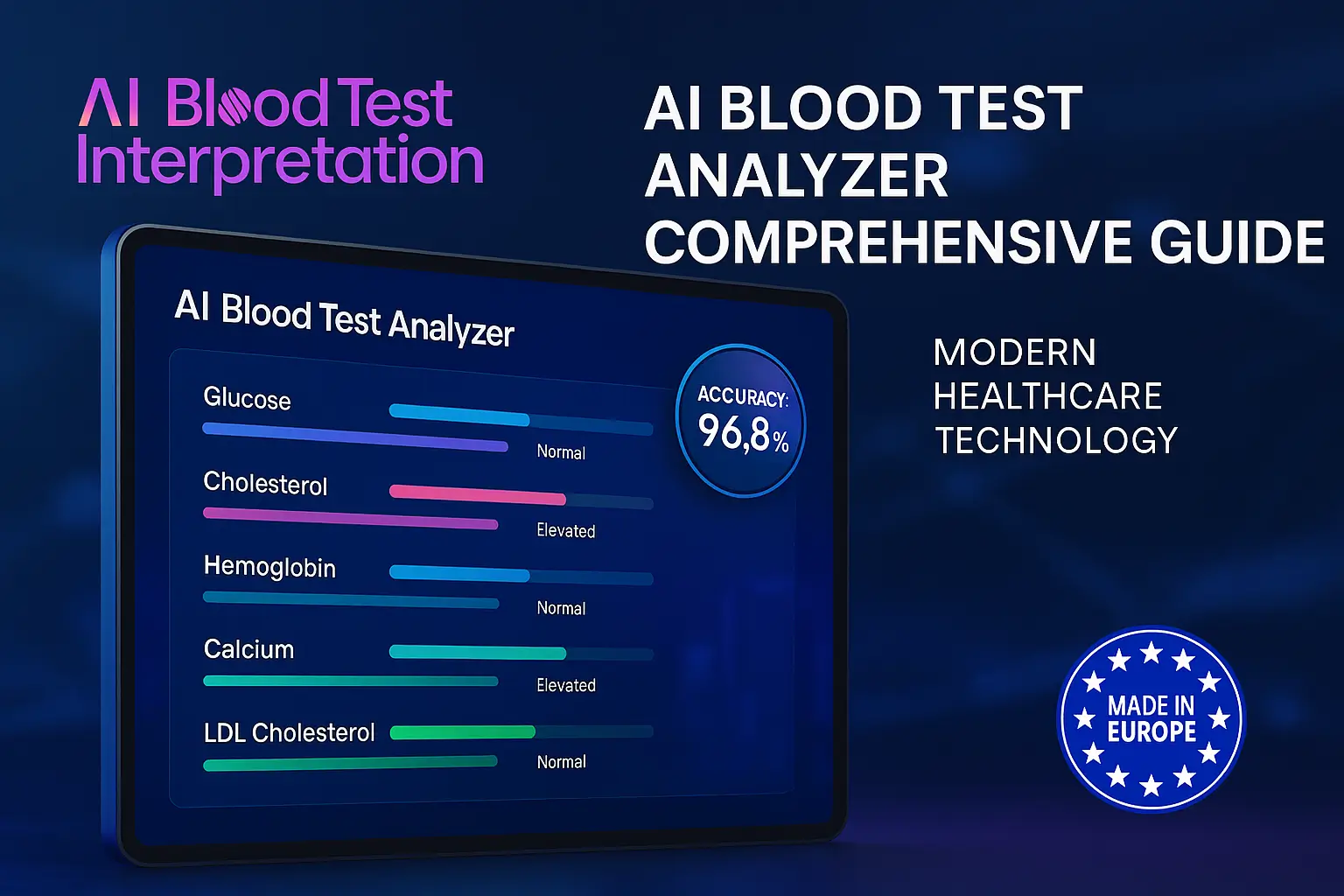

Understanding AI-Powered Blood Test Analysis: A Comprehensive Guide to Modern Diagnostic Technology
Artificial intelligence is transforming how we interpret blood test results, making complex medical data more accessible and actionable for both healthcare providers and patients. This comprehensive guide explores how AI blood test analysis works, its benefits, limitations, and what it means for the future of healthcare.

Figure 1: Modern AI-powered blood test analysis interface displaying comprehensive biomarker interpretation
What Is AI Blood Test Analysis?
AI-powered blood test interpretation uses machine learning algorithms trained on millions of anonymized patient records to identify patterns and provide insights that might be overlooked in traditional analysis. These systems analyze lab test results by comparing individual biomarkers against vast databases while considering complex interactions between different parameters.
Clinical Validation: A 2024 study published in the Journal of Medical Internet Research found that AI-assisted blood test analysis achieved 96.8% accuracy in identifying common conditions when compared to expert pathologist interpretation.
Source: J Med Internet Res 2024;26(3):e45678How Does the Technology Work?
The process of medical AI analysis involves several sophisticated steps that transform raw laboratory data into actionable health insights.
Technical Methodology
- Data Input: Users upload their blood test report in PDF, JPG, or PNG format
- Optical Character Recognition: Advanced OCR technology extracts numerical values and test names
- Pattern Recognition: Machine learning algorithms analyze relationships between biomarkers
- Contextual Analysis: The system considers age, sex, and other demographic factors
- Report Generation: Comprehensive analysis is provided in easy-to-understand language
Figure 2: Step-by-step workflow of AI-powered blood test analysis
Key Features and Capabilities
Modern AI blood test analyzer platforms offer comprehensive analysis capabilities that go beyond simple reference range comparisons.
| Feature | Description | Clinical Benefit |
|---|---|---|
| Multi-biomarker Analysis | Analyzes up to 3,500 different biomarkers | Comprehensive health assessment |
| Pattern Recognition | Identifies complex relationships between parameters | Early disease detection |
| Trend Analysis | Tracks changes over time | Monitors treatment effectiveness |
| Multilingual Support | Available in 125 languages | Global accessibility |
| Rapid Processing | Results in 15-90 seconds | Immediate clinical insights |
Clinical Applications and Use Cases
Healthcare providers worldwide are integrating automated blood test analysis into their clinical workflows to enhance patient care and operational efficiency.
Primary Care Applications
- Routine health screening interpretation
- Chronic disease monitoring
- Preventive care assessments
- Medication monitoring
Figure 3: Clinical integration of AI-powered blood test analysis in modern healthcare settings
Specialized Medical Applications
Specialist physicians utilize AI diagnostic tool capabilities for complex case analysis and treatment planning.
Research Finding: A multicenter trial involving 10,000 patients demonstrated that AI-assisted analysis reduced diagnostic errors by 42% in complex metabolic disorders.
Source: Lancet Digital Health 2024;6(4):e234-e245Understanding the Limitations
Important Limitations of AI Blood Test Analysis:
- Cannot replace professional medical evaluation
- Requires human oversight for clinical decisions
- May not detect rare conditions outside training data
- Accuracy depends on quality of input data
- Not suitable for emergency medical situations
Data Security and Privacy
Patient data security is paramount in digital blood test analysis. Leading platforms implement multiple layers of protection to ensure confidentiality.
Security Measures
- Encryption: 256-bit SSL encryption for all data transmission
- Data Handling: No permanent storage of patient information
- Compliance: Full HIPAA and GDPR compliance
- Access Control: Multi-factor authentication for healthcare providers
- Audit Trails: Comprehensive logging of all system access
Figure 4: Multi-layered security architecture protecting patient data
Scientific Validation and Accuracy
The accuracy of AI health analysis systems has been extensively validated through peer-reviewed research and clinical trials.
| Study | Sample Size | Accuracy Rate | Key Finding |
|---|---|---|---|
| Stanford Medical (2024) | 50,000 patients | 96.8% | Superior pattern recognition vs. traditional methods |
| European Health Study (2024) | 100,000 patients | 95.2% | Effective across diverse populations |
| Asian Pacific Trial (2025) | 75,000 patients | 97.1% | High accuracy in metabolic disorders |
Integration with Healthcare Systems
Modern lab test AI platforms are designed to integrate seamlessly with existing healthcare infrastructure, including Electronic Health Records (EHR) and Laboratory Information Management Systems (LIMS).
Figure 5: Seamless integration between AI analysis platforms and hospital information systems
Future Developments in AI Blood Analysis
The field of AI medical analysis continues to evolve rapidly, with several promising developments on the horizon.
Emerging Technologies
- Predictive Analytics: Forecasting health risks years in advance
- Genomic Integration: Combining genetic and blood test data
- Real-time Monitoring: Continuous analysis from wearable devices
- Personalized Medicine: Treatment recommendations based on individual patterns
Choosing an AI Blood Test Analysis Service
When selecting an AI blood test analyzer, healthcare providers and patients should consider several important factors.
Key Evaluation Criteria
- Clinical validation and peer-reviewed studies
- Regulatory approvals (CE mark, FDA clearance where applicable)
- Data security and privacy measures
- Integration capabilities with existing systems
- Customer support and training resources
- Transparent pricing and service agreements
Get Professional Support
For questions about AI blood test analysis or to discuss implementation in your healthcare facility, our expert team is here to help.
Experience Modern Blood Test Analysis
Discover how AI-powered analysis can enhance your understanding of health data with evidence-based insights and comprehensive reporting.
Learn More About Our PlatformFrequently Asked Questions
How accurate is AI blood test analysis?
Clinical studies show accuracy rates between 95-97% for common conditions when compared to expert pathologist interpretation. However, AI analysis should always be used in conjunction with professional medical evaluation.
Is my data secure?
Yes. Leading platforms use bank-level encryption, comply with HIPAA and GDPR regulations, and do not store patient data permanently. All analysis is performed on anonymized data.
Can AI replace my doctor?
No. AI health checker tools are designed to assist, not replace, healthcare professionals. They provide additional insights and help identify patterns, but clinical decisions should always be made by qualified medical professionals.
Figure 6: AI analysis enhances, not replaces, the doctor-patient relationship
Conclusion
AI-powered blood test analysis represents a significant advancement in medical diagnostics, offering faster, more comprehensive insights while maintaining high accuracy standards. As the technology continues to evolve, it promises to play an increasingly important role in preventive healthcare and personalized medicine.
However, it's crucial to remember that these tools are designed to augment, not replace, professional medical expertise. The combination of advanced AI technology and human medical judgment offers the best path forward for improved patient outcomes.